
What is a Descriptor of God?
In a recent post, God is not only God. He is our God, I shared that Moses scattered sixty-one descriptors or attributes of God across the 959 verses of Deuteronomy. Moses capitalized on his last moments in leadership to repeatedly point his people to God, the only One powerful enough to sustain them in the Promised Land. He took care to paint an intricate portrait of our very complex God, though at best, even with such detail, we have mere glimpses of God. In the following paragraphs we will define what we mean by descriptor of God.

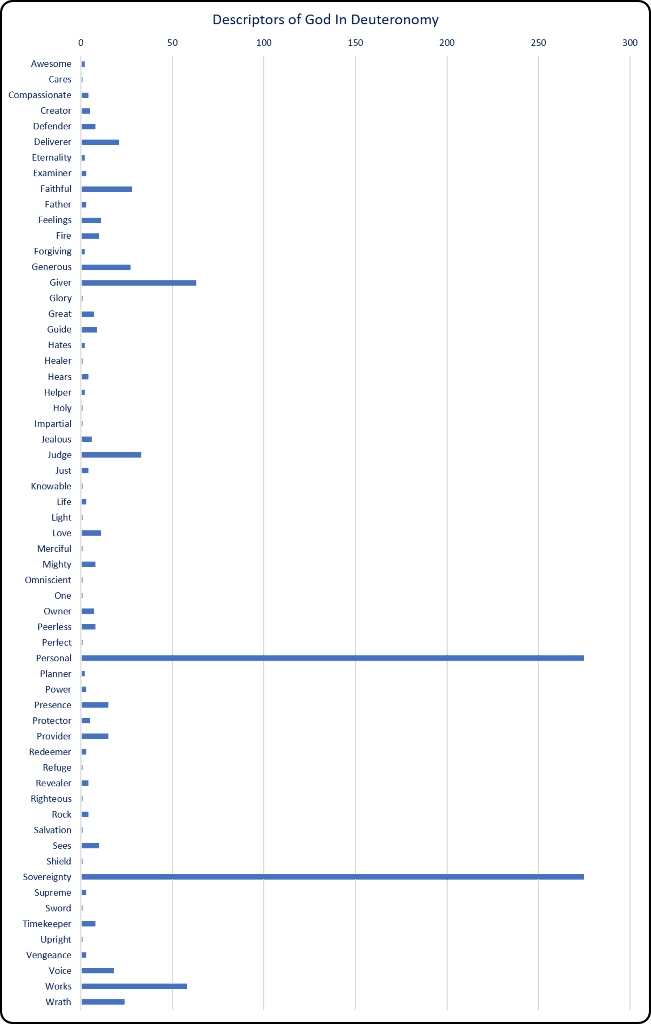
I’ve tabulated 1035 specific references to these descriptors in Deuteronomy although some verses include more than one hit for the same attribute. In those cases I counted the finding as one. I’ve included a visual at the end of the article to help us grasp the extent of this paint-by-number masterpiece Moses compiled. Only the book of Psalms has more hits on the descriptors of God.
Readers may have differing opinions about the chosen labels for these descriptors, but the important issue is the awareness that God has stocked a vast warehouse with revelations about Himself awaiting discovery. Open Scripture and explore!
What is an attribute?
Some speakers, when teaching about God, refer to attributes of God, and inquiring minds ask, “What is an attribute of God? What facts are we attempting to grasp about Him?” I will borrow the definition of attribute from the writings of A. W. Tozer whose books have long been accepted as standards for the study of God and His attributes. Tozer writes:
We must remember that the attributes of God are not component parts of the…Godhead nor elements out of which He is composed. A god who could be composed would not be God at all but the work of something or someone greater than he, great enough to compose him…The Bible and Christian theology teach that God is an indivisible unity…from whom nothing can be taken and to whom nothing can be added.[1]
…an attribute of God is whatever God has in any way revealed as being true of Himself.[2]
An attribute…is how God is.[3]
[An] attribute…is something which God has declared to be true of himself…An attribute of God is something we can know about God.[4]
What is a descriptor?
Glimpses of God will employ the word descriptor along with attribute. Descriptor includes the standard aspects of an attribute as defined by Tozer, but the term broadens the scope to include:
- Who God is
- What God is like
- What God has revealed to be true about Himself
- What God does
- How God does what He does
The word descriptor refers to the words and labels Bible writers used to share ideas about God. Bear in mind that one descriptor may appear more often than another, God’s sovereignty compared to God’s love for example. Based on the number of mentions love ranks number seven among the descriptors tracked by this work, though the count does not imply that God’s love is less important than His sovereignty (the most-mentioned descriptor). God is all-the-time loving, and He is all-the time sovereign.
Some descriptors paint God in human terms so that we might relate to Him. I have trouble grasping what God is like when the Bible states that He is Spirit (John 4:24). But when God’s Word shares that He has feelings and exhibits emotions I get that. God can be pleased (2 Peter 1:17), He delights over honest business dealings (Proverbs 11:1), He grieves over sin (Genesis 6:6), and He laughs (Psalm 37:13).
God desires to be in a thriving relationship with each of us. He sees us, and He knows our thoughts, ambitions, and desires. In turn, He has revealed glimpses of Himself so that we might know more about Him.
God’s names reveal much about Him
Readers desiring to accelerate their learning and understanding of God and His character might consider a study of God’s names as used in Scripture. Elmer Towns writes:
“Can you imagine two persons getting to know and love each other without knowing each other’s names?…There are three primary names of God in the Old Testament: (God (Elohim), LORD (Jehovah or Yahweh) and Lord/Master (Adonai). Beyond these, God is called by over 80 other compound names or descriptive titles.[5]”
I’m happy to offer this abbreviated resource list as a staring point. Some of the books may be borrowed from the Internet Archive though an account (free) is needed.
Bartosik, Dr. Rick. article “The Names of God.” Mililani Community Church. https://mcchawaii.org/wp-content/uploads/2015/06/6-Theology-Names-of-God.pdf Accessed July 25, 2026.
Blackaby, Henry T. and Claude V. King. Experiencing God. Nashville: Broadman and Holman Publishers. 2004.
Evans, Tony. The Power of God’s Names. Eugene: Harvest House Publishers. 2014.
Richards, Larry. Every Name of God in the Bible. Nashville: Thomas Nelson Publishers. 2001.
“Rose Bible Basics: Names of God and Other Bible Studies.” Tyndale House Publishers. https://files.tyndale.com/thpdata/firstchapters/978-1-59636-203-1.pdf Accessed July 25, 2026.
Towns, Elmer. My Father’s Names. Ventura: Regal Books. 1991.
The Promised Graphic
And finally, here is the promised graphic showing the descriptors of God used in Deuteronomy along with their frequency. I opted to exclude the references to conserve space. In coming sessions we will take a deeper dive into some of these descriptors. I hope you can join me!
Note: The wheat image used in the photo above is courtesy of Nicky at Pixabay.
[1] Tozer, A. W. The Knowledge of the Holy + The Pursuit of God + God’s Pursuit of Man. Chicago: Moody Publishers. 1961 + 2006 +1978. p 422.
[2] Tozer, A. W. The Knowledge of the Holy + The Pursuit of God + God’s Pursuit of Man. Chicago: Moody Publishers. 1961 + 2006 +1978. p 32.
[3] Tozer, A. W. The Knowledge of the Holy + The Pursuit of God + God’s Pursuit of Man. Chicago: Moody Publishers. 1961 + 2006 +1978. p 37.
[4] Tozer, A. W. The Attributes of God: Volume 2 Deeper into the Father’s Heart. Chicago: Moody Publishers. 2015. p 17.
[5] Towns, Elmer. My Father’s Names. Ventura: Regal Books. 1991. p 9.

Hey John,
I fully understand that God is all of these attributes all of the time, but I find it very interesting that Personal and Sovereign far eclipse the attributes that God chose to reveal or declare about himself to Moses.
Thank you for your dedication and commitment to follow God’s call on your life.
Bob,
Great to hear from you. Moses loved his people, knew he was on the way out, and understood (because God told him) the temptations Israel would face in Canaan. He used the phrases Lord our God, Lord you God, and Lord my God over and over (~275 times) to emphasize the personal relationship the nation had with God and to remind them that only the Sovereign God could give success in Canaan. This has been, is, and will continue to be a fantastic study for me. God really took pains to leave us bucket loads of data on who He is and what He is like. May God bless you!
John