
Moses Spotlighted God’s Personal Nature and His Sovereignty
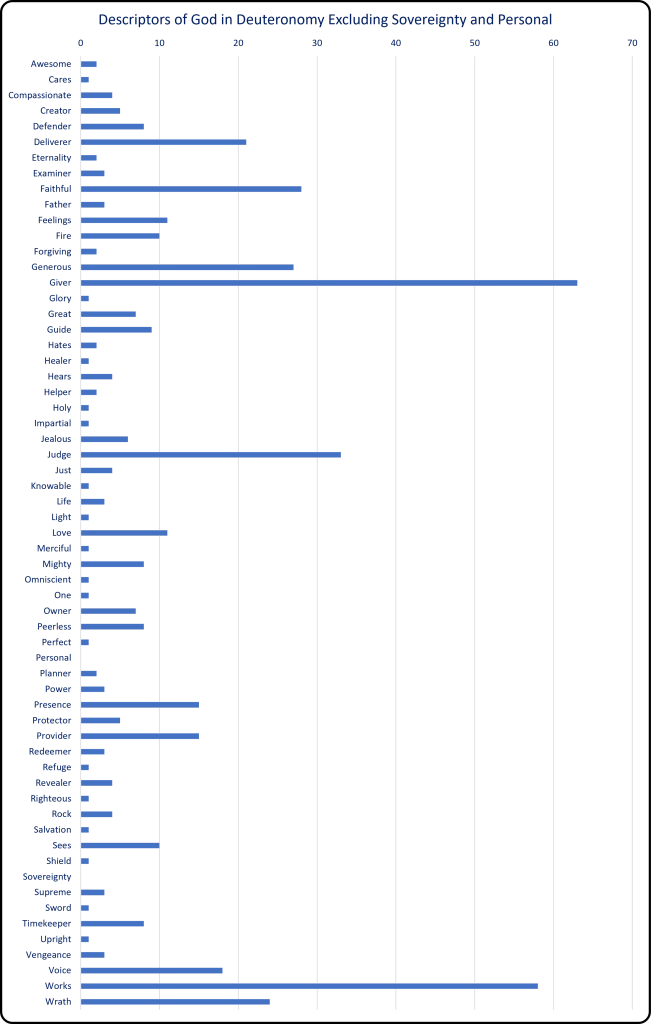
Through his final book, Deuteronomy, Moses availed himself of one last chance to counsel the people of Israel, to warn them, and to point them to God. He stressed two descriptors of God repeatedly, and as we saw in the previous post, What is a Descriptor of God?, personal and sovereignty outnumber by a huge margin the other fifty-nine descriptors Moses used. I’ve included an updated chart today which squelches the sovereignty and personal counts to highlight the detailed brush strokes Moses used in his description of God.
God’s prophecy for Israel’s future.
Why hammer personal and sovereignty so emphatically? God gave Moses a sneak preview of Israel’s coming years, and their future appeared foreboding. Rather than steam clean Canaan as God commanded, the Israelites would compromise their faith, embrace Canaanite religions, wallow in the worship of false gods, and incur the wrath of God.
The LORD said to Moses, “Behold, you are about to lie down with your fathers; and this people will arise and play the harlot with the strange gods of the land, into the midst of which they are going, and will forsake Me and break My covenant which I have made with them. “Then My anger will be kindled against them in that day, and I will forsake them and hide My face from them, and they will be consumed, and many evils and troubles will come upon them; so that they will say in that day, ‘Is it not because our God is not among us that these evils have come upon us?’ “But I will surely hide My face in that day because of all the evil which they will do, for they will turn to other gods. Deuteronomy 31:16-18 NASB
Have you invested years in a group or a project only to watch it fizzle? Discouraging, huh? Especially when you are certain you’ve been doing the work at God’s command and for His glory. Keep this verse in mind, dear servants, and take courage:
For God is not unjust so as to forget your work and the love which you have shown toward His name, in having ministered and in still ministering to the saints. Hebrews 6:10 NASB
Moses fired his last rounds in Deuteronomy, and desperately hoped to hit the target, maybe change the trajectory of people he loved with all his heart. Let’s dig in and discover what Moses communicated about God through these two descriptors, personal and sovereignty.
What do we mean when we describe God as personal?
Throughout Scripture I’ve found more than 800 instances where God is portrayed as personal. More than 200 of those, 31%, appear in Deuteronomy. These are spots where God is described as “the God of XYZ,” meaning that XYZ, be it an individual or a group, is in a relationship with God. God is labeled in these verses in syntax such as:
- Your God
- Our God
- My God
- The God of Israel
- The God of Jacob or Isaac or Abraham or someone else
Think about the mind-blowing opportunity of living within a thriving relationship with Almighty God. The Creator desires that fellowship, and He initiates its formation. It seems that the higher one climbs in our culture the more difficult access to that person becomes. Layers of “protectors” shield the lofted one from interruptions. Well, God is the highest Being, and yet with all He has to do, He has time for you and me.
- God hears our prayers.
- He listens as we worship.
- He’s honored when we thank Him for His blessings.
- God cares about our broken hearts, disappointments, and hurts.
- He celebrates our achievements and successes as any parent would.
- He’s never too busy to comfort us and dry our tears.

We can claim Him as Father and enter the relationship with Him courtesy of the finished work of Jesus on the cross.
“Come to Me, all who are weary and heavy-laden, and I will give you rest. “Take My yoke upon you and learn from Me, for I am gentle and humble in heart, and YOU WILL FIND REST FOR YOUR SOULS. “For My yoke is easy and My burden is light.” Matthew 11:28-30 NASB
But as many as received Him, to them He gave the right to become children of God, even to those who believe in His name, who were born, not of blood nor of the will of the flesh nor of the will of man, but of God. John 1:12-13 NASB
‘Behold, I stand at the door and knock; if anyone hears My voice and opens the door, I will come in to him and will dine with him, and he with Me. Revelation 3:20 NASB
A relationship with God does not mean that we keep Him on speed dial for emergencies only. God yearns to walk with us daily, to do life with us, and to bring His wisdom into our decisions. He opens the door, but the choice to enter is mine.
What is God’s sovereignty?
Unraveling God’s sovereignty is a complex study. We’ve already posted a couple of articles on the topic in the Glimpses of God series:
Expect more. Scripture includes instance after instance where that sovereignty is on display. With more than 1600+ hits, 200+ in Deuteronomy alone, God’s sovereignty is the key we must carry into our Bible study and consider in our life choices. Understanding that He is sovereign can make the difference between a joy-filled life and a sour disposition when adversity crosses our paths.

What do we mean when we say that God is sovereign?
- There is no higher being or authority. No court of appeals to review His actions. No one to veto His choices.
- God alone has the right to govern the universe since He alone created it.
- God did not create the world, wind it up and leave it to run all on its own. He is on the job overseeing everything.
- All that He does is done in love.
- Often His choices make absolutely no sense to us, certainly when our lives are upended by an unexpected development. We may want to cry, “Why, God?”, yet we must understand that God remains in control. He is never surprised by any event.
- God has complete knowledge of the past, present and future.
- God is infallible. He makes no mistakes.
And these points are only the beginning for our understanding of God’s sovereignty. Please allow me to share several outstanding quotes from other writers who defined sovereignty.
Start with this simple yet profound image from Rubens Ruba…
The first picture we have from Isaiah was, “I saw the Lord sitting upon a throne, high and lifted up (Isaiah 6:1).
Seated.
Not pacing back and forth.
Not wringing His hands.
Not struggling or searching.
He was seated, settled, secure, and certain. But why? It is because He is in absolute control.[1]
Arthur Pink published an entire book on God’s sovereignty and captured these insights on God’s sovereignty.
The sovereignty of the God of Scripture is absolute, irresistible, and infinite. When we say that God is sovereign we affirm His right to govern the universe which He has made for His own glory, just as He pleases…We affirm that He is under no rule or law outside of His own will and nature, that God is a law unto Himself, and that He is under no obligation to give an account of His matters to any.[2]
Pastor Chuck Swindoll sharpens our focus on the definition of God’s sovereignty.
Whoever is sovereign must have total, clear perspective. He must see the end from the beginning. He must have no match on earth or in heaven. He must entertain no fears, no ignorance, and have no needs. He must have no limitations and always know what is best. He must never make a mistake. He must possess the ability to bring everything to a purposeful conclusion and an ultimate goal. He must be invincible, immutable, infinite, and self-sufficient. His judgments must be unsearchable and His ways unfathomable. He must be able to create rather than invent, to direct rather than wish, to control rather than hope, to guide rather than guess, to fulfill rather than dream. Who qualifies? You guessed it…God and God alone.[3]
Sovereignty means our all-wise, all-knowing God reigns in realms beyond our comprehension to bring about a plan beyond our ability to alter, hinder, or stop. Let me go further. His plan includes all promotions and demotions. His plan can mean both adversity and prosperity, tragedy and calamity, ecstasy and joy. It envelops illness as much as health, perilous times as much as comfort, safety, prosperity, and ease. His plan is at work when we cannot imagine why, because it is so unpleasant, as much as when the reason is clear and pleasant. His sovereignty, though it is inscrutable, has dominion over all handicaps, all heartaches, all helpless moments. It is at work through all disappointments, broken dreams, and lingering difficulties. And even when we cannot fully fathom why, He knows. Even when we cannot explain the reasons, He understands. And when we cannot see the end, He is there, nodding, “Yes, that is my plan.[4]”
And finally, these words are from E. M. Bounds, a Methodist preacher known for eight books on prayer published from his notes after his death. Bounds wrote…
“God is everywhere, watching, superintending, overseeing, governing everything in the highest interest of man, and carrying forward his plans and executing his purposes in creation and redemption. He is not an absentee God. He did not make the world with all that is in it, and turn it over to so called natural laws, and then retire into the secret places of the universe having no regard for it or for the working of His laws. His hand is on the throttle. The work is not beyond His control. Earth’s inhabitants and its affairs are not running independently of Almighty God.[5]”
Let me close with another quote from Rubens Ruba. (I enjoyed his book immensely.)
…hopelessness is the biggest source of stress in life and a rock-solid belief that God is sovereign is the cure.[6]
Another chart showing descriptors of God in Deuteronomy
I re-charted the descriptors of God in Deuteronomy and excluded the counts for personal and sovereignty to give readers a better grasp of the depth of Moses’s masterpiece of God. Our God is truly an awesome God, and He reigns in heaven above as well as in the earth below.
The most important question we will ever answer is, “Does He reign in my heart?”
[1] Ruba, Rubens. Who Is God? North Charleston: CreateSpace Independent Publishing Platform. 2016. p 26.
[2] Pink, Arthur W. The Sovereignty of God. Blacksburg: Wilder Publications. 2008. p 17.
[3] Swindoll, Charles R. The Mystery of God’s Will. Nashville: Word Publishing. 1999. p 85.
[4] Swindoll, Charles R. The Mystery of God’s Will. Nashville: Word Publishing. 1999. p 87.
[5] Bounds, E. M. The Complete Works of E. M. Bounds on Prayer. Niche Edition, 2011. Kindle edition.
[6] Ruba, Rubens. Who Is God? North Charleston: CreateSpace Independent Publishing Platform. 2016. p 166.